Thambal
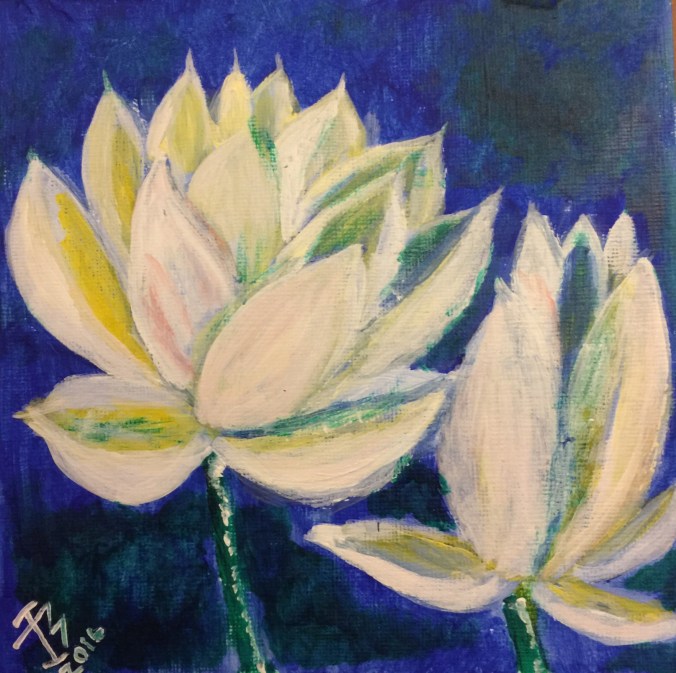 An acrylic painting by Monica Ingudam
Thambal
An acrylic painting by Monica Ingudam
Nene Rebita
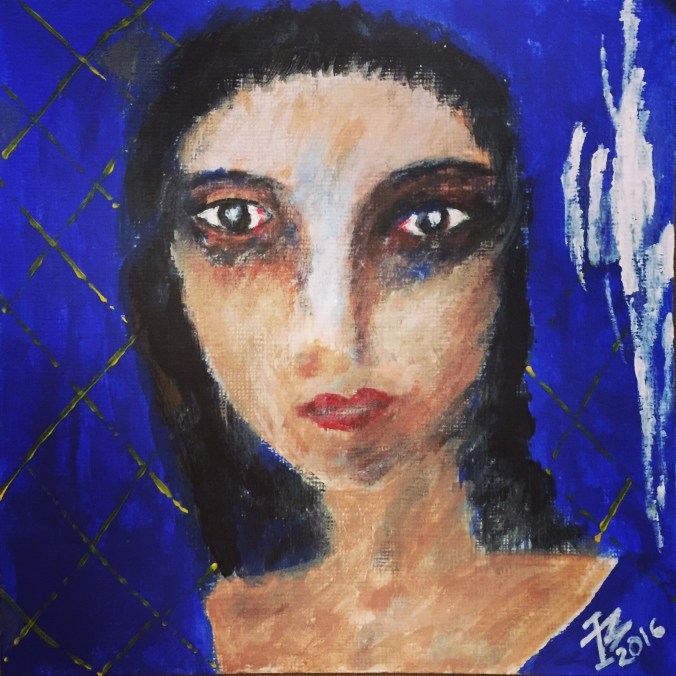
An acrylic painting by Monica Ingudam
About FindingTheVoices:
Born and raised in the violence-torn landscape of Manipur, I have a vision to promote and spread inspiring, empowering, educative & entertaining stories. I believe that we can create contents bringing the positive side of Manipur. I believe we can do this together by finding the voices, voices which needs to be heard and shared, voices of our own people, people of Manipur and well-wishers of Manipur. I believe that these voices will bring a change and connect all of us.
The slap across Nemkina’s face
A short story by Monica Ingudam
I was never good at speaking up in class while I was in School. It wasn’t like I didn’t know the answer to the questions the teachers posed. I knew the answers to most questions but I was scared to speak up. I don’t know whether it was the education system or the culture I grew up. Children then were encouraged to listen while the elders and teachers spoke. The teachers and elders spoke almost 90% of the time. Listening was encouraged. Agreeing without questioning was even better. So I became a listener, a very good listener. I had my questions, lot of questions but those questions didn’t leave my lips and mostly it stayed in my mind.
I was in 9th grade. Many things happened that year. To start, that was the year my mother coaxed me to cut my long straight black hair to a smart “Boy’s cut” as she called. My mother has her way with words. She took me to a beauty parlour at Paona Bazaar in Imphal, the first I have ever gone. The beauty parlour was on the first floor, on top of a cycle shop. It had pictures of beautiful Korean girls with fancy hairstyles on the walls and big mirrors all over. I sat on the big black rotating chair and I could see myself in the front mirror and also see the back view of my hair in the mirror behind. I have never seen these different angles and views while cutting my hair. My haircuts before were by my neighbors, and mostly they made terrible mistakes like cutting my front bang too short. So I had a good reason and opted to grow my hair then. My hair seemed much longer in the reflection and the skilled guy with a girlish voice started cutting my hair. He chattered, and I pretended to listen, but I wasn’t. My heart started sinking watching him cut my long hair which he picked strand by strand and clipping the remaining hair with the fancy long clip. I felt like crying and I wasn’t sure why I agreed to cut my hair. But I didn’t cry, and said nothing. I went through the haircut, the haircut I picked myself pointing to poster of the beautiful Korean girl on the wall. Mother and the guy with girlish voice were praising on how smart I looked with the new hair cut. I nodded and looked at my reflection with the short “Boy’s cut” hair. My pink and white threaded sweater which I had got for Yaoshang (Holi) that year seemed a little mismatched with my new hairstyle. I followed Mother and walked down the small steep staircases.
Nemkina was aghast to see my hair cut at School and she didn’t hide her disappointment. And that is what I loved about her. She would say what she felt and I could express mine easily to her. She was in the boarding school and we shared secrets. And those secrets remained with us. Secrets she had told no one but me, as we play on the luscious green grass right in front of the cave. The cave with the stone statue of Mother Mary with a white robe. This was one of our favorite spot, a spot where the loveliest flowers bloomed. Nemkina’s father was no more, and her mother had gone “mental” as she puts it. Namkina said her mother had witnessed him burn alive. This happened during the ethnic clashes between the Naga and Kuki tribals in Manipur. She said she was lucky to be alive and escaped the massacres. Tears welling up she added that thirteen children abandoned by panic-stricken elders, were burnt alive in her village, the Taloulong village at Tamenglong district. And so I was told that I should never tell the others which tribe she belonged. She had the fear of being identified and fall in the hands of the haters.
Though Nemkina was grateful to the nuns for taking her in and providing the best shelter and education, she hated getting up early do the chores specially on the cold winter days where she had to sweep and mop the school floors. She was bored of the food too, eating boiled mustard leaves on most days then. She would give me Rs 2 from the money her uncle had given her on the rare times she got visitors to get her favorite sweet puff. I would get a pack which had 10 pieces, take 2 pieces for myself and give the 8 pieces packed nicely. Each puff piece was 25 Paise if sold separately, so that would make 8 puff pieces for Rs 2. My math was perfect and I didn’t feel the need to tell her then, that I ate 2 of the delicious puffs sprinkled with crystals of sugar. I felt I deserved it for the errand I was running for her. I would pass it to her and she would smuggle it back in her school bag to her boarding room. Probably she would have shared the puff with me but the puff was so tempting and I couldn’t resist those huge crystal sugars glaring back at me with the “eat me” look. I think Nemkina knew it but she played along by not sharing. Because if she didn’t know, she would have shared at least one puff, but she didn’t share.
It was an afternoon class after the break and I can’t quite recall if it was a Math or Science class. But It was Sir Kumar’s class. He took Math and Science. He was a non Manipuri teacher with pepper grey hair. Most of the non Manipuri teachers were from south India but Sir Kumar wasn’t. I was not sure where he was from, maybe from somewhere in North India. I thought he was very intelligent. He was very good in explaining the concepts. I could follow, visualize and understood what he taught, as he wrote with chalks on the black board. I respected him as a teacher and held him at a high place. That afternoon, he was in a foul mood. One moment he was teaching, standing near the black board and suddenly he rushed to where Nemkina was sitting after he caught her dozing off. He started yelling, asking her to explain what he was teaching. He saw her notebook and threw it on the floor. Nemkina stood abruptly. I could see her movement as she was sitting diagonally from where I was sitting. Sir Kumar slapped across Nemkina’s face once followed by a pin drop silence in the class. Before I could recover from what had happened, I heard another slap and he turned to the class to ask if anyone was listening.
 He was so angry and I was scared that he was going to hit Nemkina again, so I stood up and walked towards the front where the teacher’s table and chair was placed and put my notebook on the table. He walked away from Nemkina towards the teacher’s table and sat on the chair. He asked me some questions which I answered looking straight into his eyes and he gave back my book and said “Bold, very bold Laishram Tonu Devi”. I continued looking straight in his eyes without blinking as I took my book back and said “It’s Tonu Laishram Sir”
After that day, my friendship with Nemkina and my respect for Sir Kumar changed. I was filled with guilt. I wasn’t sure whether I was guilty because I didn’t speak up for her to alert about the incident to an elder or for not talking with her about the incident, which might have made her feel better. I asked many a questions before I slept and had many sleepless nights “Why didn’t anyone speak up for her? Why didn’t I speak up? The class was full. Sir Kumar must be a coward, he must have picked Nemkina because he knew that she didn’t have anyone to speak for her. But If Sir Kumar had done this to Neeta or Christine who had influential parents, there would be a protest and he would have been expelled not only from the School but maybe even out of Manipur. No one, including myself spoke up for Nemkina. What kind of friendship are we talking about? I had failed her, as her friend, as a human being. I should have spoken up for her. And I carry the pain and humiliation of that slap with a deep guilt even today. I am sorry Nemkina.
~The End~
Collection of short stories written by Monica Ingudam. These stories are fiction based on Life’s this and that focusing on Manipur and the people of Manipur.
Bungo’s Body
A short story by Monica Ingudam
It was the summer of 2012. It’s been more than 4 years now but the grief hasn’t reduced a bit. People say that time is a healer but I am yet to experience that. How can one get over the loss of someone so young, specially if there was no good bye. But death doesn’t come with notice. Does it? You think I am indifferent and have no sympathy or empathy for the policeman who have died, because I will not comply to your kind of protest? You want me to march, intimidate the people, join you in breaking and smashing the vehicles of the people who are breaking the protest you have called? The very kind of protest which got my son into trouble, making us send him to New Delhi for his studies.
 Let me tell you a little bit of my son. He just turned 17 that year. He was an early riser and will wake up definitely before 4:00 AM before the sunrise without any alarm clock. He would diligently water the rows and rows of “kobi” (cabbage) and “nakuppi” (Chives) plants before he resumed to his morning study. I loved to listen to his reading, though I didn’t understand English much. He said he needed to work on his pronunciation. I didn’t know what was the right way but Bungo said he was having trouble with words with “z” and “s”. To me he sounded like an Englishman who spoke flawlessly, the ones who came to Manipur long ago, the ones my grandmother described to me as a child.
Bungo was to become a Computer Science Engineer. He said he could get a job without paying any bribes outside of Manipur just like Da (big brother) James. Bungo said Da James travelled to beautiful places as part of his job, gets to stay and eat in all these fancy expensive places we see in the movies. Bungo wanted to see the beautiful sights of the world and explore the different cultures of the world. He is also paid extra in addition to his salary for the foreign trips he is assigned as part of his work. Bungo said in 5 years he will start earning and I didn’t have to go to the market selling vegetables anymore.
Despite the financial situation, “Mapa” (his father) and me decided to send Bungo to New Delhi where he can have uninterrupted education and can be focused in his studies. He was very troubled and distracted after the group attack he had on his way back from School on one of the protest days. He wouldn’t tell me exactly what happened but I heard that he was surrounded by many angry locals including young and old, male and female and was roughed up with words and his bicycle was smashed so badly that the rim had to be changed.
Bungo went to New Delhi with dreams and hope. That is a world I don’t know about. What would I know? I have never stepped out of Manipur. I didn’t grew up talking on the phone so it’s hard to have a conversation with Bungo. Our conversations would limit to studies, hostel food and monthly money requirement. Maybe I should have tried and be up to date with the modern ways of life and communication, maybe I should have known more of his life and thoughts. Maybe I should have understood the challenges of fitting in a new city. There are lot of combination of “maybe” and “could have” but that wouldn’t change the day I got the news that Bungo passed away, the newspaper, the one and only coverage, said an “alleged” suicide, hanging from the fan. What does “alleged” even mean? We don’t even have a ceiling fan at home, how can Bungo think of the fan at New Delhi?
I was angry with “Mapa” (his father) for not noticing any signal when he spoke 2 days before to Bungo. I was even angrier with his friends in his school and hostel. I was angry with everyone. I was mostly angry with myself. What could have made my little boy take that action? Wy didn’t I make him feel close enough for him to share his thoughts? Was it even him who did it? “Mapa” got Bungo’s body in the flight, a flight ride Bungo never got when he was alive. He travelled by bus and then by train.
And you are asking me that I am not supportive of your protest. You want me to show my anger and react violently? My little boy could have been alive. He wanted to travel and see the world beyond the place he was born. This unrest which you are adding to, is causing many pangs of separation in one form or another, as a ripple effect. Yes you, you are a part of it. He had dreams and hope. But he couldn’t have a life in Manipur or out of Manipur. So Who should I fight? Fight the protestors who intimidated Bungo? Fight the mainland Indian (as you call) for the “alleged” racism, bullying, isolation driving Bungo to hang from a ceiling fan? Fight the people around Bungo, including me for not understanding him and cutting his life short? Or should I fight the government?
The ex gratia of 5,00,000 Indian Rupees which the politician readily announced nor the justice promised nor the violent protest will ease the grief or erase the picture of the policeman curled up at the back of a dirty van in his own pool of blood. That will stay just as the sight of Bungo’s body. A body I couldn’t connect to, with a bluish green distorted face and an open mouth. I have never seen that expression in Bungo. My bungo I know looked through with a shy smile, spiky hair wearing his old red school sweater as he watered while I weed the plants. That is what I want to remember but we can’t really un see what we saw or changed what had happened. The dead is gone and the grief stays. I don’t know how to mend it but I know that this violence is not the way.
~The End~
Collection of short stories written by Monica Ingudam. These stories are fiction based on Life’s this and that focusing on Manipur and the people of Manipur.
Madam Saroj Nalini Ingudam presented a paper on the use of banana leaves in 1987-88 during her M. Phil course as she felt that the traditional custom of using banana leaves were slowly fading in Manipur. Her paper was made possible with the help of a few learned scholars and practitioners of the art form and was very well received at Manipur University. In this second episode, Madam Saroj describes how banana leaves are used along with betel leaf, coconut, ginger and flowers as a form of invitation for traditional ceremonies in Manipur. The different arrangements of the invitations for different persons are show with the help of pictures in this episode. Just by looking at the form of arrangement, one would be able to tell whether the invitation was for the King, Queen or other members of the royal family. Different structural arrangements are also available for Arangbham, Brahmins and the common people.
Madam Saroj also talks about the form of society during the reign of monarchs. She says that the justice system in those days was very different from the one that we have today, which is very slow in delivering judgments. She feels that there has been a rise in crime in the present society because of the slow pace of the justice system.
About FindingTheVoices:
Born and raised in the violence-torn landscape of Manipur, I have a vision to promote and spread inspiring, empowering, educative & entertaining stories. I believe that we can create contents bringing the positive side of Manipur. I believe we can do this together by finding the voices, voices which needs to be heard and shared, voices of our own people, people of Manipur and well-wishers of Manipur. I believe that these voices will bring a change and connect all of us.
Banana leaves are used in a number of occasions in various regions of India. In Manipur, these leaves are used during religious rituals as well as a form of invitation for certain traditional customs. This episode is dedicated to the significance of banana leaves in Manipur, a documentation of the art form that has been practiced since the time of Kings and Queens. Madam Saroj Nalini Ingudam presents very thorough information on this practice with the help of her M. Phil paper from 1987-88. Banana leaves are used in every major ritual in a person’s life; starting from birth ceremonies (Swasti Puja, Yupan Thaba), “Na Hutpa”, marriage ceremonies, and also during funeral rituals. There have been a few changes in the way the leaves are used during rituals, for example, the “Tang Yatpa” came into practice only after the arrival of Hindu religion in Manipur. However, the same old practices are still followed without any change in traditional Meitei festivals like “Lai Haraoba”.
Madam Saroj also talks about the different variety of banana leaves and their purposes; Leihou La, Leiyai La, Changbi La, Noney La to mention a few. The most commonly used is the Noney La, which is suitable for use in feasts because of its odorless quality. Madam Saroj also describes a little about how these leaves were so commonly used as invitations before the printed version of invitations came out. A description of how banana leaves are used as invitation for Shri Govindaji is shown towards the end of this episode.
About FindingTheVoices:
Born and raised in the violence-torn landscape of Manipur, I have a vision to promote and spread inspiring, empowering, educative & entertaining stories. I believe that we can create contents bringing the positive side of Manipur. I believe we can do this together by finding the voices, voices which needs to be heard and shared, voices of our own people, people of Manipur and well-wishers of Manipur. I believe that these voices will bring a change and connect all of us.
About FindingTheVoices:
Born and raised in the violence-torn landscape of Manipur, I have a vision to promote and spread inspiring, empowering, educative & entertaining stories. I believe that we can create contents bringing the positive side of Manipur. I believe we can do this together by finding the voices, voices which needs to be heard and shared, voices of our own people, people of Manipur and well-wishers of Manipur. I believe that these voices will bring a change and connect all of us.
Location: RKCS Art Gallery, Imphal, Manipur, India
Catch up the 1st part of his interview at FindingTheVoices with Mr. RK Budhimanta, learning about RKCS Art Gallery, Manipur.
Catch up the 2nd part of his interview at FindingTheVoices with Mr. RK Budhimanta, Art and creativity in Manipur. (Part 2)
Apart from being a painter and a sculptor, 4th generation artist of the RKCS family, RK Budhimanta also makes topiaries, creating animals and birds shaped structures from bushes and plants. His works can be seen at their garden and also along the bank of the Nambul River. The artist was also once a flora devotee, collecting varieties of flowers and winning a few prizes in flower exhibitions. Along with recreating paintings that were previously done by his father, Rajkumar Chandrajit Sana, Mr. Budhimanta also creates his own paintings to express his thoughts and send messages though the paintings. One such painting is a portrayal of skulls depicting the devastating consequences of war; another is a painting illustrating the gruesome nature of starvation in Somalia; and another is a crafty portrait of Irom Sharmila that also reveals a map of Manipur when closely examined.
Most of the paintings done by RKCS are collected and in more demand among the non-Manipuris than the people of Manipur themselves. Mr. Budhimanta says that he actually appreciates this trend and feels proud about the fact that more and more people outside of Manipur are interested in collecting and studying about the culture of Manipur. Although, he wishes that the people of Manipur would also follow this trend of collecting paintings and become a little more passionate about art. He says that there are many talented artists in Manipur but lack exposure. He wishes to bring all these artists together under one roof and establish a hub for displaying and selling their beautiful paintings for the tourists and art lovers. The artist also stresses about the difficulties they face whenever they participate in exhibitions held outside Manipur because of the lack of sponsorships from both Government and private bodies.


About FindingTheVoices:
Born and raised in the violence-torn landscape of Manipur, I have a vision to promote and spread inspiring, empowering, educative & entertaining stories. I believe that we can create contents bringing the positive side of Manipur. I believe we can do this together by finding the voices, voices which needs to be heard and shared, voices of our own people, people of Manipur and well-wishers of Manipur. I believe that these voices will bring a change and connect all of us.

 FINDINGTHEVOICES